Opinion
The Forgetting Curve Is Eating Your YouTube Binges
Last week you watched a 25-minute Ali Abdaal video on productivity systems. You followed along. You nodded. You understood the difference between time blocking, task batching, and the Eisenhower matrix — at least while the video was playing.
Can you explain all three right now?
If the answer is "not really," you're not broken. You're normal. And there's a 140-year-old experiment that explains exactly why.
The forgetting curve is not a metaphor
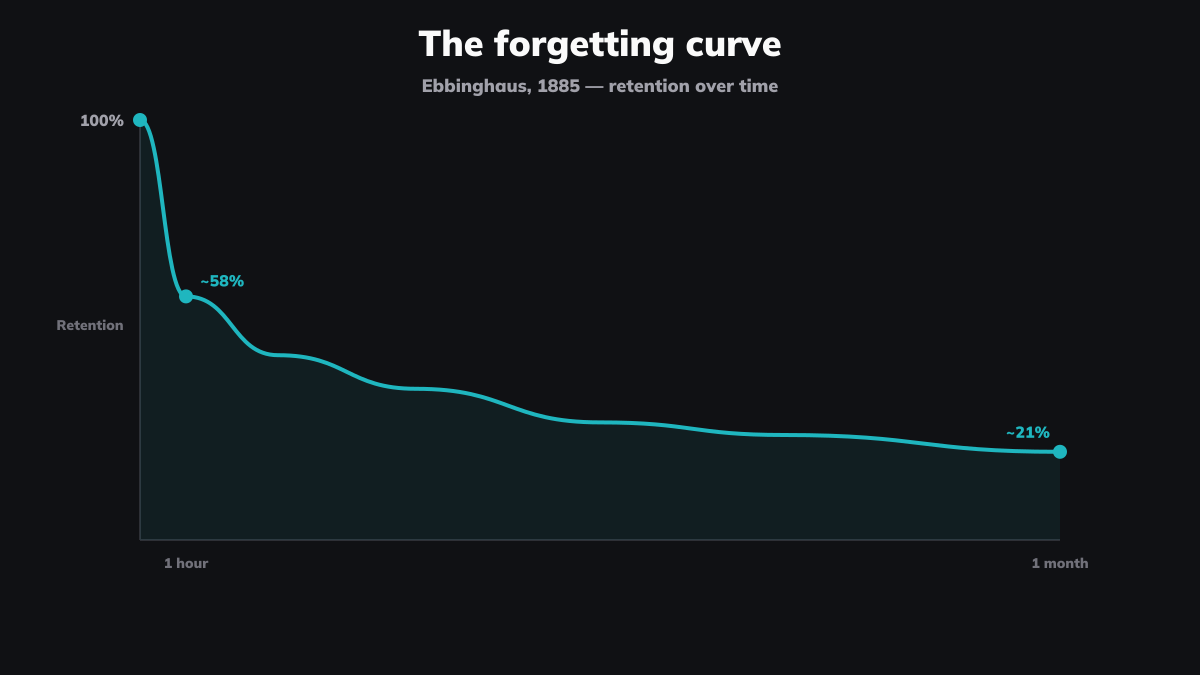
In 1885, a German psychologist named Hermann Ebbinghaus ran one of the most tedious experiments in the history of science. He memorised lists of nonsense syllables — meaningless combinations like WID, ZOL, PAG — then tested how quickly he forgot them.
His results, published as Über das Gedächtnis (Memory: A Contribution to Experimental Psychology), showed a pattern that's been replicated ever since:
- 20 minutes later: 42% forgotten
- 1 hour later: 56% forgotten
- 24 hours later: 67% forgotten
- 1 week later: 75% forgotten
- 1 month later: 79% forgotten
(Source: Ebbinghaus, 1885. Replicated with near-identical results by Murre & Dros, 2015, PLOS ONE.)
The popular claim that "you forget 70% within 24 hours" is roughly right — the actual figure from Ebbinghaus's data is 67%. Close enough to be depressing.
And here's the part that matters for YouTube: Ebbinghaus used meaningless syllables. Real educational content — a Kurzgesagt video on the immune system, say — is more meaningful, so you retain it slightly better. But the shape of the curve doesn't change. The drop is still steep in the first hours, then flattens. The specifics fade fast. The gist lingers longer. But "the gist" of a 40-minute video isn't worth much when you need the specific technique explained at the 23-minute mark.
Passive watching feels like learning — it isn't
There's a phenomenon in cognitive psychology called the illusion of fluency. When you watch a clear, well-produced explanation — and YouTube is full of them — you confuse the presenter's fluency with your own understanding. The explanation made sense while you were hearing it. That's not the same as knowing it.
A 2025 meta-analysis in Educational Research Review examined 54 studies comparing active learning strategies with passive video watching (primarily adults in STEM disciplines). The conclusion was consistent with decades of prior research: passive watching produces significantly weaker retention than any form of active engagement.
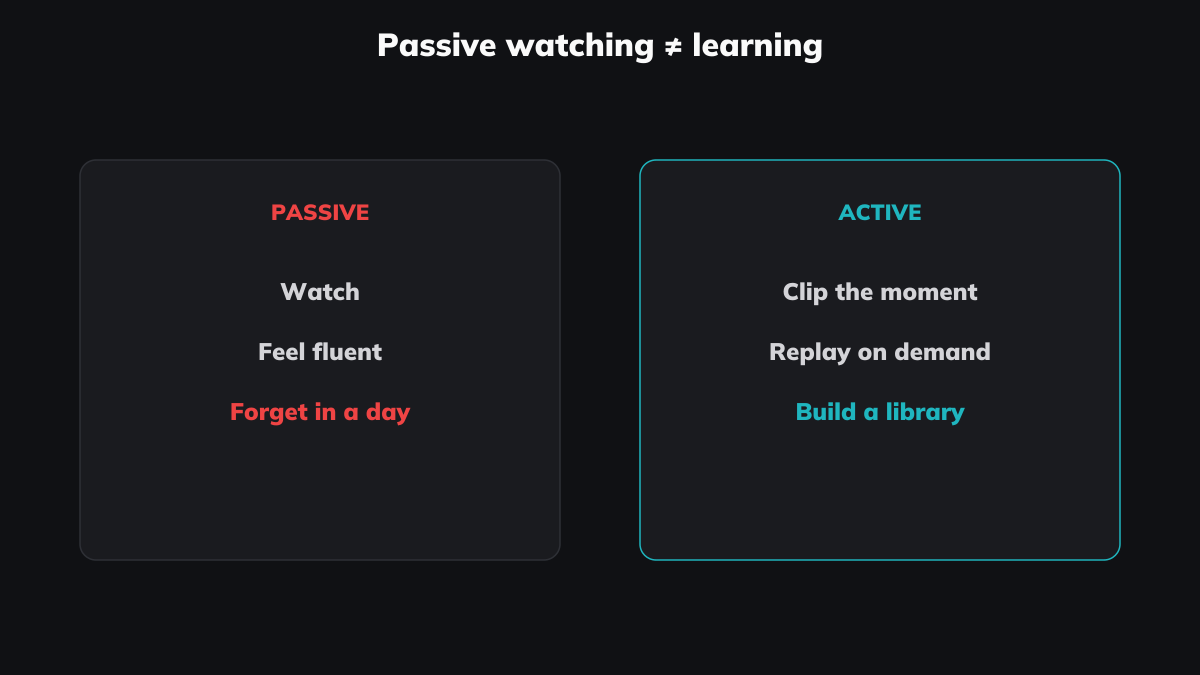
But "active engagement" is a spectrum. Taking notes is active. So is pausing to summarise. So is clipping the exact moment you need to revisit.
These are not the same thing.
The standard advice (and why it's incomplete)
Search "how to take notes from youtube" and you'll find the same seven methods everywhere: Cornell notes, mind maps, the Feynman technique, timestamp-based notes, AI-powered transcript summaries. Every article covers roughly the same ground.
All of those methods convert video into text. And text is useful — I'm not arguing otherwise. But writing "Kubernetes pods are the smallest deployable unit" in your Notion doc loses something. It loses the diagram the presenter drew. It loses the tone of voice that signalled "this is the important part." It loses the specific 45-second explanation that clicked for you, which might be different from the one that clicked for someone else.
The note is a pointer. The video is the knowledge. And most note-taking methods throw away the video and keep only the pointer.
There's a step between watching and taking notes
What if the note was the moment itself?
Not a timestamp URL you paste into a doc (you'll never click it again — be honest). Not an AI-generated transcript summary (useful for skimming, terrible for retention). The actual 30-second segment where the concept landed. Marked, saved, tagged, replayable.
This is what I think of as video extraction — pulling the specific moments out of a long video and keeping them as first-class objects in a library. Not text about the moment. The moment itself.
It's closer to how spaced repetition works with flashcards, except the "card" is a video clip. You don't study a description of the concept — you replay the explanation. The same voice, the same visuals, the same context that made it click the first time.
Cognitive research backs this up. Ebbinghaus's own work showed that relearning previously studied material takes significantly less effort — his "savings scores" proved that the memory trace persists even when recall fails. A 33% savings score at 24 hours means the relearning cost is 33% lower. Replaying a clipped moment is relearning with almost zero friction.
What this looks like in practice
Say you're watching a Thomas Frank video on note-taking systems. It's 48 minutes long. Three moments matter to you:
- The Cornell method breakdown at 6:20–7:45
- The comparison between digital and handwritten notes at 19:30–21:10
- The spaced repetition schedule he recommends at 38:15–39:40
Traditional approach: you pause, write notes, maybe paste a timestamped URL into your doc. You never look at it again. (Don't pretend otherwise. Your Notion "YouTube Notes" page has 47 entries. You've revisited two of them.)
Extraction approach: you mark the start and end of each moment while watching. Three clips. Tagged "study methods," "note-taking," "revision." When you need that spaced repetition schedule again — and you will — you search "spaced repetition," hit play, and you're watching the exact segment. Ninety seconds, not 48 minutes.
That's the difference between a bookmark and a library.
The compound effect nobody talks about
One clipped moment is barely useful. Fifty is a cheat code.
After a few weeks of clipping while you watch, something changes. You stop thinking of YouTube as entertainment-you-feel-guilty-about and start treating it as a source. Your clips accumulate by topic. The "public speaking" folder has 12 clips from 8 different creators — Vanessa Van Edwards on body language, Chris Anderson on TED talk structure, a presentation coach breaking down Obama's pauses. You can compare techniques. You can spot where your understanding breaks down — because you've saved the moments where it clicked and the ones where it didn't.
This doesn't happen with notes. Notes are flat. Notes don't let you hear the explanation in someone else's voice. Notes don't let you compare how two different experts teach the same concept with completely different approaches.
The library IS the revision system. It builds while you watch. And because each clip is short and replayable, revisiting them is almost frictionless — which is exactly what spaced repetition needs to work.
You don't have a discipline problem
If you watch 5+ hours of educational video a week and retain maybe 20% of it a month later, the problem isn't you. It isn't your attention span or your note-taking habits or your choice of videos. The problem is that video has no extraction layer. Books have highlights. Articles have clipping tools. Podcasts have show notes. Video has... a progress bar and a prayer.
That's the gap Klipptik is designed to fill — clip, tag, search, replay. The forgetting curve doesn't care how good the video was. It cares whether you engaged with the material again. Clipping is engagement. Replaying is spaced repetition. And a searchable library of your best video moments is the reference system that YouTube's Watch Later list was never going to be.
Start clipping what matters — try Klipptik free, no account required.